

The Research Council of Finland-funded DYNALake project explores new approaches for quantifying methane release from a frozen lake. The related field work was captured by a seasoned documentarist, with the final short film now available for all to see.
An aerial view pans out to reveal a wide shot over a lake with a completely frozen surface. The cold February day is both clear and calm, providing pleasant working conditions for some ice-focused field research.
We find ourselves at Lake Pääjärvi, some 120 kilometres north from the Finnish capital. A small research team is preparing necessary gear for operating both in cold and near potentially thin ice. The camera follows as the enthusiastic group embarks to conduct their research work.
“A bad day on the field is always better than a good day at the office”, Research technician Tahvo Oksanen smiles to the camera.
Advancing greenhouse gas research
Lake Ice as an Indicator of Environmental Dynamics is a 15-minute documentary film that follows researchers of University of Helsinki’s Institute of Seismology and their international collaborators during fieldwork at Lake Pääjärvi, operated out of the University of Helsinki Lammi Biological Station in the winter of 2024-2025. The Institute is part of the Department of Geosciences and Geography at the UH Faculty of Science.
“With this documentary, we aim to popularize environmental seismology with its focus on the resolution of near-surface processes using observations of elastic waves in contrast to traditional seismology targets such as earthquakes and deep Earth imaging”, says Professor Gregor Hillers, Project Manager of the DYNALake – Dynamics of a frozen lake environment project and one of the Principal Investigators of FAME.
The Research Council of Finland-funded DYNALake project explores several proof-of-concept approaches in using passive seismic tomography and interdisciplinary observation methods for quantifying methane release from a boreal lake.
Methane (CH4) is an invisible and odorless greenhouse gas that contributes significantly to global warming. While it is naturally present in Earth’s atmosphere as a by-product of such processes as wetland ecosystem interactions and animal digestive systems, methane can also be produced by landfills, fossil fuel production, and other human activities. Its atmospheric concentration is increasing rapidly and is now 2.5 times higher than that before the industrial era, yet the causes of this rise are complex and not well understood.
It is estimated that about half of the global CH4 emissions come from aquatic sources and that about 72% of the climatic impact of greenhouse gas emissions from lakes is due to methane. Sediment gas emissions – also known as ebullition, or the release of gas bubbles from lake bottoms – can make up a significant, though highly variable, portion of the total methane released from water bodies. However, ebullition is difficult to measure, and reliable estimates are still relatively scarce. This is partly because it happens irregularly and varies widely from place to place. Not only do emissions differ between lakes, but they can also change considerably within different areas of the same lake. Scientific strides in this area can advance potential solutions to combat climate change.
Making the science work visible
To gather the desired data, the research team deployed about 300 geophones, 10 broadband stations, 3 accelerometers, and an impressive range of supporting instruments. In addition to the University of Helsinki’s own instruments, the complementary systems and support were provided by the French Université Grenoble Alpes, the German University of Hamburg, the Swiss ETH Zürich, the Swedish University of Stockholm, and the Geological Survey of Denmark and Greenland (GEUS), an independent research institution under the Danish Ministry of Climate, Energy and Utilities.
During their field work in February 2025, the DYNALake team was tagged along by the French cinematographer Marc de Langenhagen. With a long-time professional association to the French national public service broadcaster France Télévisions, de Langenhagen is known for his work focusing on outdoor activities and nature, such as his 2019 Svalbard documentary Le requiem de la banquise (The Ice Flow Requiem).
According to Prof. Hillers, the interaction with de Langenhagen and his Chambéry-based Belle Etoile Production team in France has been intense, instructive, and inspiring.
“Arriving at the final version of the professionally composed and edited 15 minutes long piece can be compared to drafting a scientific manuscript for submission: there have been a lot of back-and-forth discussions, revising, and fishing-for-typos.”
With the finalised documentary now released for everyone to see on the University of Helsinki’s YouTube channel, the DYNALake team wishes to communicate the rewarding possibilities associated with integrated geoscience approaches. And, as Prof. Hillers puts it, to motivate the viewer to appreciate the environment that the researchers have the privilege to engage with for a living.
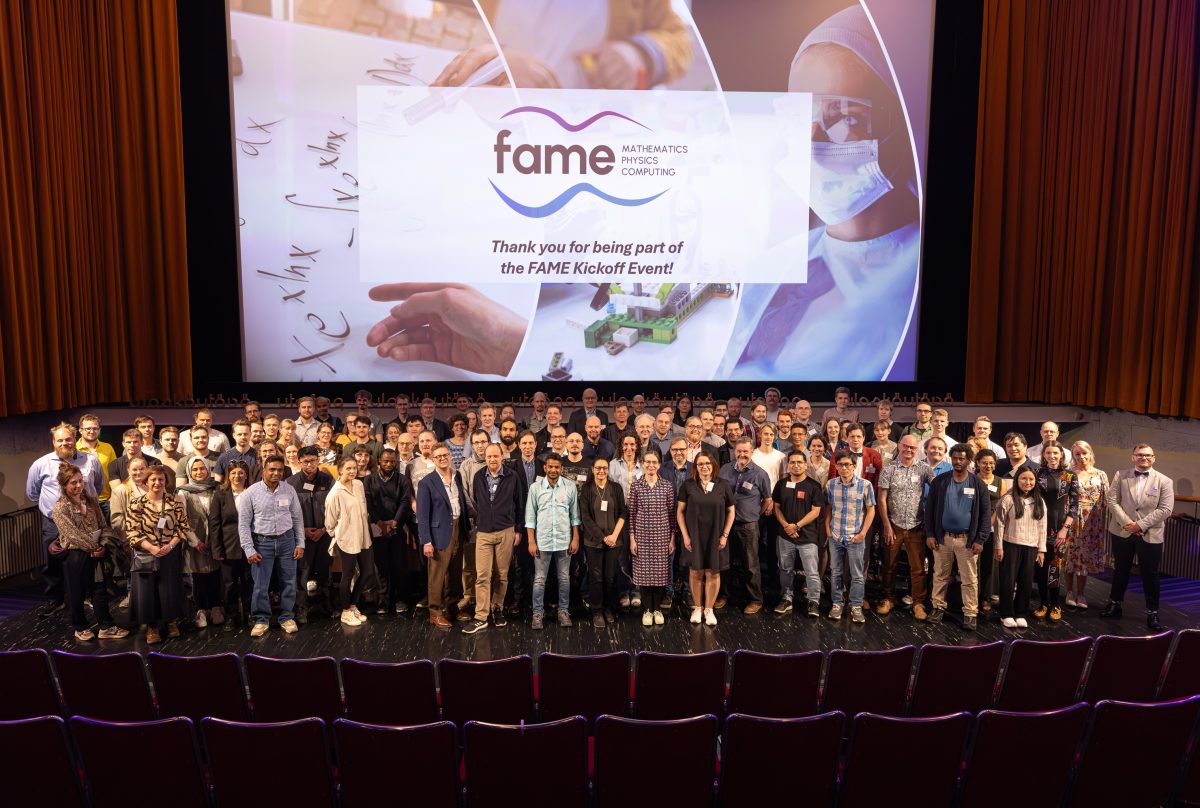
“The FAME Flagship has been supporting this endeavour, and the inversion of the collected seismic observations for ice structure and composition, and eventually for the governing environmental drivers, will benefit from tapping into the deep FAME knowledge reservoir.”
Through FAME, Prof. Hillers continues to expand his research and collaboration network in Finland to push forward subsurface imaging and monitoring techniques. The DYNALake project will continue until the end of summer 2028.