
Professor Aku Ursin’s research group at the University of Eastern Finland (UEF) is developing novel computational methods and measurement techniques for environmental and geophysical applications, including greenhouse gas (GHG) monitoring, measurement of atmospheric aerosols, wind profiling, and remote sensing of forests. While this research involves collaboration with several research groups in UEF, Finnish Meteorological Institute, Natural Resources Institute Finland (Luke), and Rutherforld Appleton Laboratory, Prof. Ursin’s group has also increased engagement with companies to foster practical utilisation of the research.
Currently, the most active research topic in Prof. Ursin’s group is laser dispersion tomography (LDT) — a novel technique for localising and quantifying GHG emissions in the facility scale. In 2025, the group carried out field experiments where LDT was applied to GHG monitoring at biogas production plants and agricultural fields. These experiments were done in collaboration with Luke and the UK-based emission intelligence company Mirico Ltd. Additionally, the group initialised collaboration with Aeromon Oy, a company that provides mobile emission monitoring services using drones-assisted sensors to help industries accurately measure, map, and manage air pollutants and GHGs.
Prof. Ursin’s research group is also actively exploring wind field profiling using ground-based Doppler Lidar. Doppler Lidars are widely used for measuring wind speed in wind energy applications, and further optimizing their performance with e.g. non-homogeneous wind fields or in complex terrain is an active field of development. Since early 2025, Ursin’s group has been collaborating actively with Vaisala Oyj to develop a novel computational solution to enhance the application of Doppler Lidar in such challenging environments.
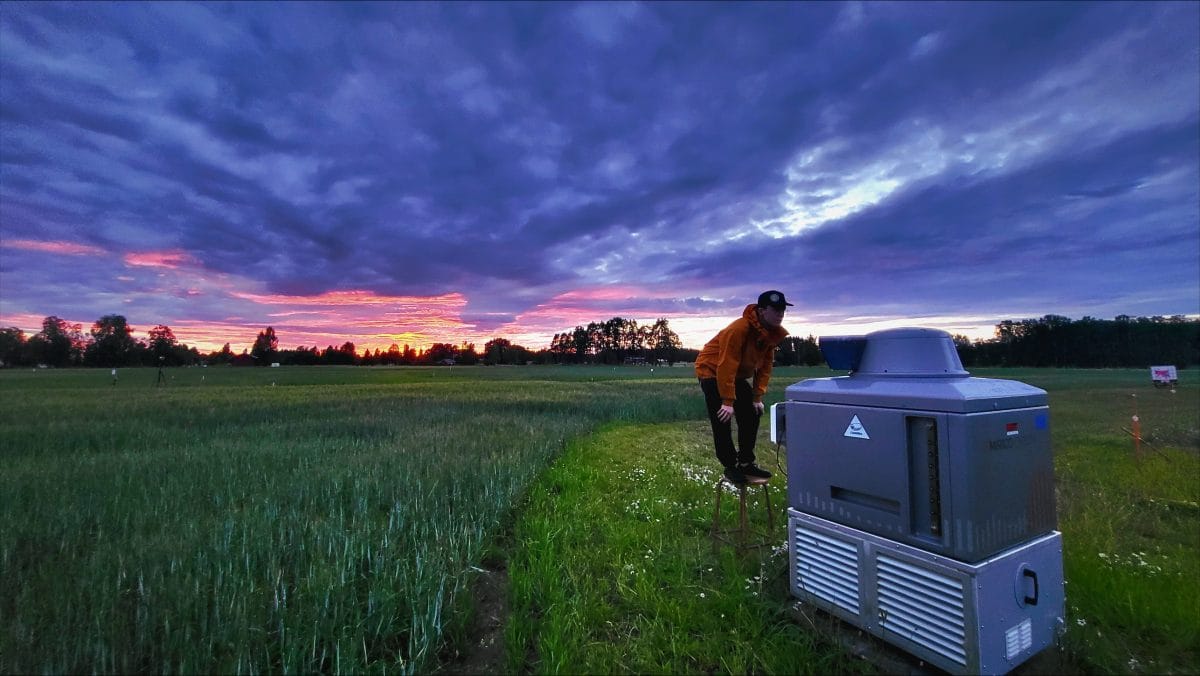
Photo: Jyri Häkkinen / UEF | UEF researcher Aaro Heikkinen examines a laser tomography device used for methane measurements at Luke’s Maaninka research site.