
The significance of mathematics for the ever-present digital photography goes often unnoticed. An open dataset to train recovering distorted images and a novel method to choose an optimal regularization parameter are introduced. Still images can be brought to life with some creative reconstruction.
In the 2013 film adaptation of James Thurber’s 1939 short story The Secret Life of Walter Mitty, the titular character (played by Ben Stiller) searches the legendary photojournalist (Sean Penn), with whom Walter works with but has never met in person. Walter’s adventure takes him to the Himalayas, where the photographer tries to catch an image of a rare snow leopard. However, when the notoriously elusive creature finally gives an opportunity to take the picture, the photographer stays still.
“When are you going to take it?”, Walter asks, to which the photographer replies: “Sometimes I don’t. If I like a moment, for me, personally, I don’t like to have the distraction of the camera. I just want to stay in it.”
As a long-time photography enthusiast, Doctoral Researcher Markus Juvonen has also learned to appreciate the beauty of fleeting moments. After spending countless of hours walking through forests and fields with a camera in hand, he also knows very well that not every single photo does come out as hoped when the time to take it eventually arrives. The subject may be too far away or too fast, the lighting conditions are may not be ideal, or one’s hands may not be steady enough. The resulting images are blurry, grainy and lacking detail – information has been lost.
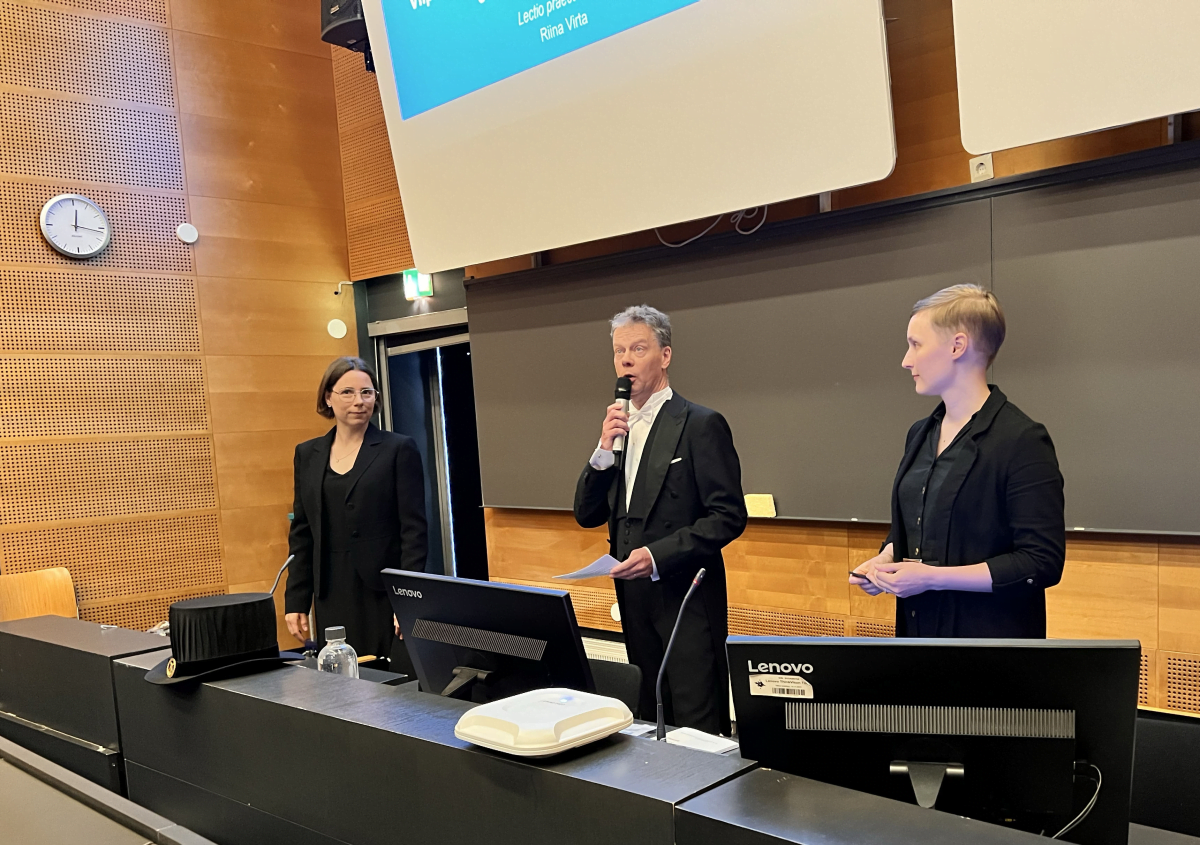
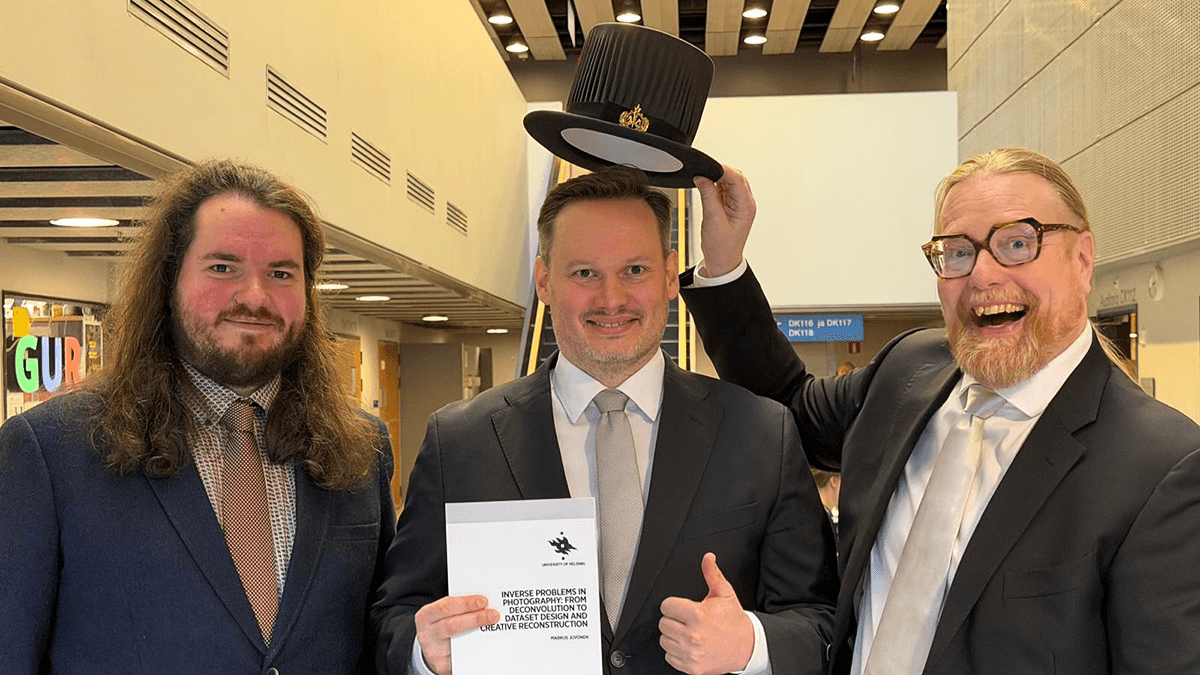
On 9 January 2026, Juvonen celebrated a significant milestone in combining his academic expertise and long-time passion for photography, as he defended his doctoral dissertation Inverse Problems in Photography – From Deconvolution to Dataset Design and Creative Reconstruction in the University of Helsinki’s Faculty of Science. Dr. Jonas Latz from the University of Manchester served as the opponent, while FAME Vice Director, Professor Samuli Siltanen served as the custos.
Image is the king
Images and videos have become one of the most prominent ways to share information in today’s fast-paced world. With essentially all modern mobile phones having a built-in camera, smartphones account for more than 90% of all photographs taken. Correspondingly, visual-first platforms YouTube, TikTok, Instagram, and Snapchat reign supreme amongst social media services, especially among teens. At the same time, the emergence and popularity of text-to-image models has increased the amount of AI-generated imagery rapidly in the last few years.
However, the remarkable amount of mathematics underlying this digital photography ecosystem goes very often unnoticed and underappreciated. Every time a photo is taken and shared, sophisticated algorithms process raw sensor data to form images, correct colour, reduce noise, and enhance sharpness, often in milliseconds. Advanced compression techniques enable efficient storage and transmission of high-resolution images and videos across global networks.
Juvonen’s dissertation investigates inverse problems in photography with a focus on three themes: deblurring misfocused photographs, automatic selection of regularization parameters, and patch-based creative reconstruction using existing image data.
“When I started at the university, I was not at all sure whether I wanted to make mathematics the main focus of my studies”, Juvonen now reminisces the start of his academic journey. “However, I had just started nature photography as a hobby and had found a way to incorporate that into my bachelor’s thesis. So, when the time came to think about my master’s studies and thesis, I was introduced to Professor Siltanen, a fellow photography-enthusiast who just so happened to run a course that involved the mathematics of image manipulation. Along the way, working with him eventually snowballed into doctoral research.”
Juvonen’s first thesis paper introduces the design work and producing of open image dataset for the international Helsinki Deblur Challenge 2021 competition in which the participants were tasked to recover the original picture from blurred and distorted images.
As inverse problems are typically ill-posed – meaning, they may lack a unique and/or stable solution altogether – some form of regularization is needed. In regularization, prior knowledge or constraints are being added so that the problem will be able to prefer certain solutions over others.
The second thesis paper of Juvonen’s dissertation introduces a novel dual-grid method to choose an optimal regularization parameter. The method was tested on real and simulated photographic data, showing flexibility and proving to achieve robust image deblurring results with both.
“Since much scientific attention and funding is being directed to medical imaging – and deservedly so – I am glad that there has been room and opportunities for me to experiment something different and be involved in so many interesting projects”, Juvonen says gratefully.
(Creatively) applied mathematics
During his doctoral studies, Juvonen cultivated a strong interest in science communication and artistic approaches for sharing information. While working with Professor Siltanen, Juvonen had an opportunity to not only help produce science videos aimed at public, but also to participate in organising a workshop at the University of the Arts Helsinki’s Academy of Fine Arts that brought together mathematicians and visual artists.
The third and final thesis paper in Juvonen’s dissertation allowed him to combine mathematics with some out-of-the-box creativity. The paper introduces a method to create animated images from existing still photo data. This is done by breaking the original images into patches, grouping the similar ones into clusters with a machine learning algorithm called k-means clustering, and reconstructing the image by matching and randomly sampling from these clusters.
By emphasising reinterpretation over replication, this approach blends variational thinking with perceptual, artistic, and communicative aims.
“At one point it was seriously considered whether it would be possible to arrange a mathematics-themed art exhibition as part of my dissertation work. While that did not materialise, I have had an opportunity to focus my doctoral researcher position’s teaching duties to first assist in and eventually take charge of an introductory course on mathematics of photography. My hope is that I can continue to share knowledge on a subject that I am passionate about in the future as well”, Juvonen concludes.
Photo: Samuli Siltanen | From the left: The opponent, Dr. Jonas Latz from the University of Manchester, Doctoral Researcher Markus Juvonen fresh out of the public defence, and FAME Vice Director, Professor Samuli Siltanen.