
A novel regularization method was investigated to separate different materials from each other more clearly in CT reconstructions. Successful tests with simulations and real data demonstrate potential for further development. Shared enthusiasm can give a great boost to explore new areas.
“From a very young age, I had dreamed about entering to the Faculty of Veterinary Medicine to become a vet. I was told that to do so, I would need to study a lot of mathematics, chemistry, and physics. So, that’s what I did.”
Just like natural sciences, life can be full of surprises, variables, and unknown factors leading to significant developments. As her first attempt to enter veterinary education did not pan out, Salla-Maaria Latva-Äijö decided to focus on physics studies to further hone her skills while waiting for the next chance. However, as fate would have it, she instead found a new fascination and drive from the world of physics. Many moons later, Latva-Äijö had not only earned her master’s degree in Biophysics and Medical Physics but also decided to pursue a doctorate in the field that had once so unexpectedly changed the outlook of her academic future.
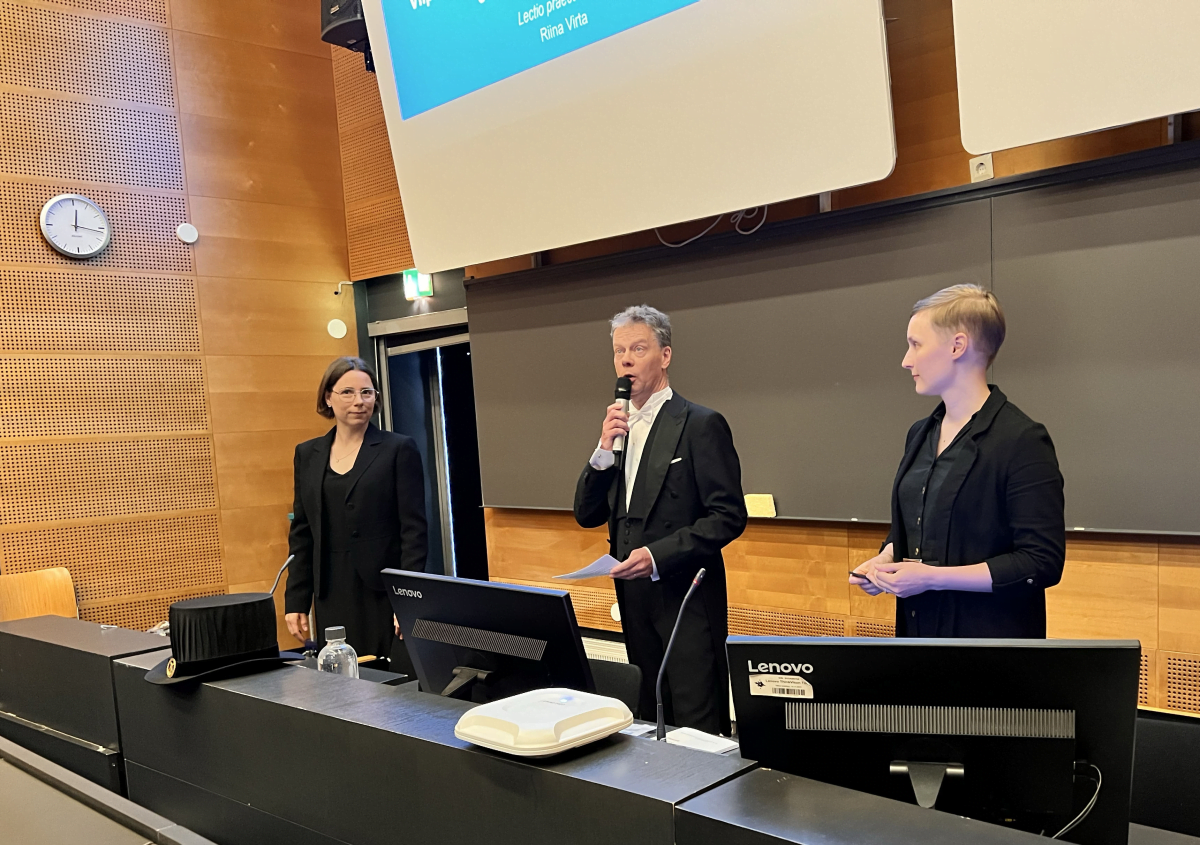
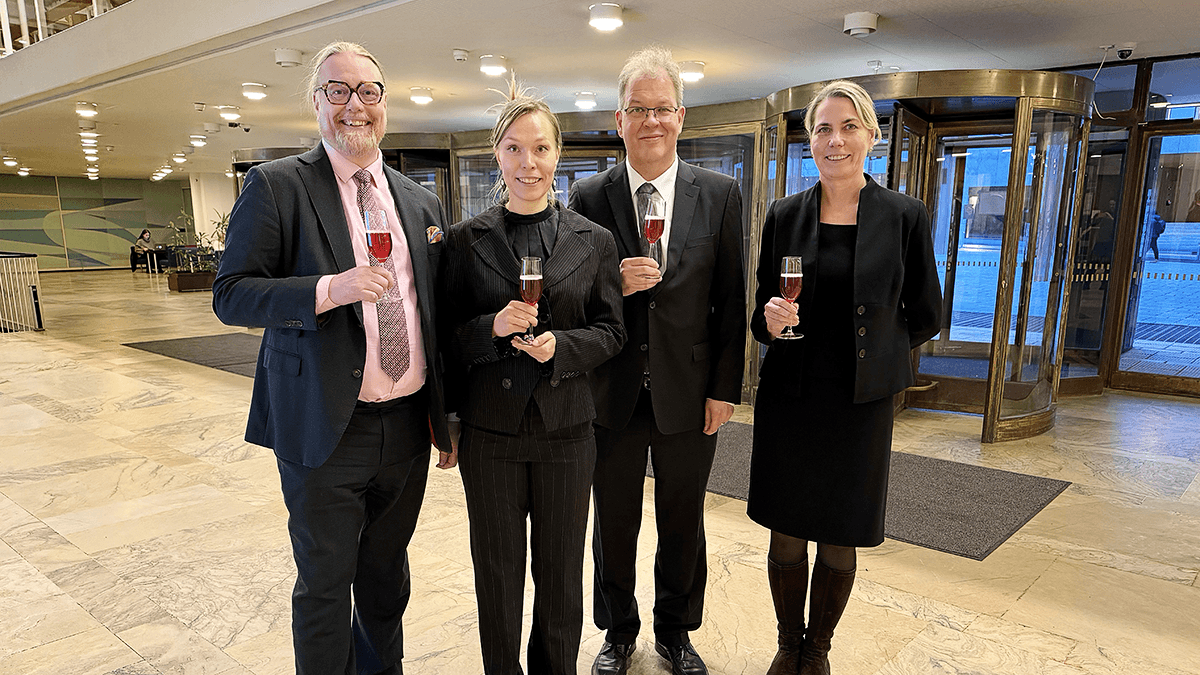
On 27 November 2025, Doctoral Researcher Latva-Äijö closed one chapter in her scientific journey by defending her doctoral dissertation Novel Algorithms for Material Decomposition and Classification in Spectral CT Imaging at the University of Helsinki’s Faculty of Science. Alongside her were two FAME Principal Investigators: Research Professor Johanna Tamminen from the Finnish Meteorological Institute serving as the opponent, and Professor Matti Lassas from the University of Helsinki serving as the custos.
In a gray area
Latva-Äijö’s thesis focused on an inverse problem related to the X-ray computed tomography (CT), a non-invasive imaging technique used widely in medical diagnostics, research, and industrial applications. In CT imaging, the fundamental mathematical problem involves reconstructing a three-dimensional object from its two-dimensional projections – essentially recovering the internal structure of an object from its “shadows.” Solving this inverse problem requires knowledge of physics, mathematics, and computational algorithms, such as mathematical optimization.
As a fresh Master of Science, Latva-Äijö had at first explored many different options and possible approaches for her thesis work. Having previously worked as a research assistant in a project aiming to achieve CT scans of a moving object, Latva-Äijö had gained knowledge on the fundamentals of X-ray tomography. Eventually, it was her former project leader, then-supervisor, and future-Vice Director of the FAME Flagship, Professor Samuli Siltanen, that nudged her into an inspiring direction.
After some initial planning and task-setting, Latva-Äijö and her co-researchers set their sights on finding mathematical solutions to improve the material decomposition in spectral CT, a type of computed tomography that uses X-rays of different energy levels to obtain more detailed information about materials inside the target object.
“I was fascinated by the idea of bringing some colour to traditional black-and-white X-ray images”, Latva-Äijö reminisces. “The thought was that with this quite novel technique it might be possible to produce images with fuller spectrum of colour, turning visible some of those materials that would otherwise just appear as gray mass. This would give us more information and spare patients from excessive radiation exposure.”
Proof-of-concept
In the first phase, which would eventually turn into Latva-Äijö’s first dissertation article, the team tested a new approach for reconstructing separate tomographic images of two different materials.
Inverse problems are typically ill-posed, which means that a unique solution may not exist, or that it is very unstable. Solving such problems requires designing and implementing a suitable regularization strategy, a collection of techniques to make an ill-posed problem well-posed by adding extra information or constraints to make the problem prefer certain solutions over others.
Latva-Äijö and her colleagues introduced a regularization term which uses the properties of the so-called inner product (IP) – a mathematical concept for measuring similarity between two images – to separate different materials from each other more clearly in reconstructions. After demonstrating with simulations that this method could classify the different materials, the team moved on to validate their method with real data reconstructions of objects simulating human tissue. The success of these tests suggests that their approach may have applications in material science, chemistry, biology, and medicine.
“Of course, we started with the simplest possible case first. That is, we selected as straightforward scenario as possible to prove that our method not only works but that it has a lot of potential yet to be explored”, Latva-Äijö describes. “In the history of mathematics, it has been quite common that at first something so theoretical gets developed that it is not immediately clear for what it could be used for. Only to be found useful at some later point with some unpredictable applications.”
The curtain call
In her third and final dissertation article, Latva-Äijö and her colleagues took what at first appears as quite a sidestep. Shifting their focus to machine learning, the team studied the training process of support vector machines (SVMs). As SVMs try to separate objects into categories as clearly as possible, the aim was to improve classification performance while maintaining computational efficiency.
As often happens in vibrant research fields, the inspiration to venture more experimental areas was sparked by peer-support and shared enthusiasm.
“We all participated in this great workshop in Rome which focused on machine learning-related topics. As we were split into working groups, I found myself in one with a topic that was not exactly familiar to me. However, the atmosphere and drive within the group was excellent once we started working and throwing ideas. And as we were able to advance both our theory and code quite a lot for our presentation, we all felt that we should see our work to the end and write an article”, Latva-Äijö praises her co-writers.
And by all accounts, it seems that this is just one example in a long list of great experiences and warm memories.
“I am immensely grateful for the opportunities that my research has provided me to see the world and to meet truly wonderful people and exceptional researchers. This has been a great journey, and I would not change any of it. Except maybe a day or two”, Latva-Äijö concludes with a smile.
Photo: Samuli Siltanen | From the left: Prof. Samuli Siltanen, Doctoral Researcher Salla-Maaria Latva-Äijö, Prof. Matti Lassas, and Prof. Johanna Tamminen.